Understanding Crown Material Selection and Preparation Requirements
A Guide to Dental Crown Materials and Tooth Preparation
Material selection should happen before final tooth preparation whenever possible. KATANA Zirconia HTML PLUS, KATANA STML or UTML, IPS e.max CAD, porcelain-fused-to-metal, and full-cast gold do not require the same amount of restorative space. Preparing first and choosing the material afterward can leave the laboratory with inadequate clearance, an overcontoured crown, or a restoration that falls below its required thickness.
The matrix below provides a practical starting point for common crown-and-bridge materials. It separates manufacturer minimum restoration thickness from clinical reduction because those measurements are related but not interchangeable. Final preparation design should account for the prescribed material, restoration type, occlusion, cement space, esthetic plan, preparation height, margin location, and laboratory workflow.
Quick clinical note: Treat every number in this matrix as a minimum, not an automatic depth-cut target. Confirm the exact material, indication, and current instructions for use before preparing the tooth.
Crown Material Selection & Prep Requirement Matrix
| Material & Indication | Published Minimum Thickness or Clearance | Preferred Preparation Form | Important Case Considerations |
|---|---|---|---|
| KATANA Zirconia HTML PLUS, anterior crown | 0.4 mm minimum zirconia thickness | Chamfer or rounded shoulder with smooth internal geometry | High-strength zirconia can accommodate a thinner restoration than more translucent formulations, but clearance must still support proper contour, occlusion, and milling. |
| KATANA Zirconia HTML PLUS, posterior crown | 0.5 mm minimum zirconia thickness | Chamfer or rounded shoulder; rounded line angles | Appropriate where strength and conservative preparation are priorities. Heavy contacts may require more space than the material minimum. |
| KATANA Zirconia STML, anterior crown | 0.8 mm minimum zirconia thickness | Rounded shoulder or chamfer without sharp internal angles | Balances translucency with strength for anterior crowns and eligible short-span restorations. |
| KATANA Zirconia STML, posterior crown | 1.0 mm minimum zirconia thickness | Rounded shoulder or chamfer with adequate functional clearance | Do not apply the 0.5 mm HTML PLUS value to STML. The more translucent formulation requires greater thickness. |
| KATANA Zirconia UTML, anterior crown | 0.8 mm minimum zirconia thickness | Rounded shoulder or chamfer; smooth transitions | Designed for high-esthetic applications. The stump shade, material translucency, and required masking should be considered before preparation. |
| KATANA Zirconia UTML, posterior crown | 1.0 mm minimum zirconia thickness | Rounded shoulder or chamfer with adequate occlusal clearance | Indicated only when the material’s strength, span limitations, and occlusal demands fit the case. |
| IPS e.max CAD, minimally invasive adhesively cemented crown | 1.0 mm throughout | Circular shoulder or pronounced chamfer at least 1.0 mm wide; rounded internal angles | Adhesive cementation is mandatory for the 1.0 mm crown design. It is not the default for bridges, implant crowns, or every parafunctional case. |
| IPS e.max CAD, standard anterior crown using the staining technique | 1.5 mm incisal; 1.2 mm circular | Rounded shoulder or pronounced chamfer | Offers additional ceramic volume for contour and esthetics when a minimally invasive design is not selected. |
| IPS e.max CAD, standard posterior crown using the staining technique | 1.5 mm occlusal; 1.5 mm circular | Rounded shoulder or pronounced chamfer | Requires more uniform clearance than high-strength zirconia. Avoid sharp angles and uneven ceramic thickness. |
| PFM crown using a conventional metal-ceramic design | Approximately 1.5 mm occlusal, 2.0 mm incisal, and at least 1.1 mm where metal plus porcelain must be accommodated | Chamfer for a metal margin or shoulder for a ceramic margin | Reduction depends on which surfaces receive porcelain, the selected alloy, framework design, and esthetic requirements. |
| Full-cast gold or full-cast metal crown | Generally 1.0–1.5 mm occlusal clearance with a 0.3–0.5 mm chamfer | Conservative chamfer with rounded internal angles | The functional cusp may require additional clearance. Confirm the prescribed alloy and laboratory design before using the most conservative value. |
Minimum Material Thickness Is Not Always Prep Depth
A 0.5 mm minimum wall thickness does not automatically mean that a uniform 0.5 mm tooth reduction will produce an acceptable crown. The restoration still needs space for cement, anatomical contour, marginal design, occlusal adjustment, milling limitations, and the functional relationship with the opposing dentition.
For example, KATANA Zirconia HTML PLUS permits a 0.5 mm minimum posterior crown thickness according to its manufacturer. If the preparation provides only 0.5 mm of clearance at a heavy functional contact, however, the laboratory has no room for cement space, finishing, adjustment, or anatomical development without compromising the final design.
Evaluate preparations from the intended external contour inward. A reduction guide, preliminary scan, or diagnostic design can show whether the available space is distributed correctly instead of merely meeting one measurement at an isolated point.
How KATANA Zirconia Formulations Change the Prep
KATANA Zirconia is a family of materials rather than one universal zirconia. HTML PLUS, STML, UTML, and YML have different layer structures, translucency levels, strengths, indications, and minimum thickness requirements.
HTML PLUS permits thinner anterior and posterior crown walls because it is designed around higher strength. STML and UTML require at least 0.8 mm for anterior crowns and 1.0 mm for posterior crowns. Applying the thinner HTML PLUS dimensions to a more translucent KATANA formulation would place the restoration below the manufacturer’s stated requirement.
The selection should therefore be written precisely on the prescription. “Zirconia crown” does not tell the technician whether your priority is maximum strength, greater translucency, masking, a specific bridge span, or minimal reduction.
The preparation must also avoid features that concentrate stress or interfere with milling. Rounded internal angles, a readable continuous margin, adequate taper, and enough clearance throughout the complete range of movement give the laboratory a better foundation than a preparation that reaches the minimum in only one area.
When IPS e.max CAD Requires More Space
IPS e.max CAD is a lithium disilicate glass-ceramic selected for esthetic crowns, veneers, inlays, onlays, and other approved indications. Its preparation requirements differ from those of high-strength zirconia.
Ivoclar permits a 1.0 mm minimally invasive crown when the clinical conditions meet the manufacturer’s requirements and adhesive cementation is used. That protocol should not be confused with every IPS e.max CAD crown. Standard anterior and posterior designs using the staining technique require greater incisal, occlusal, or circular thickness.
The preparation should have a rounded shoulder or pronounced chamfer, smooth transitions, and no sharp internal angles. Material support should remain consistent rather than alternating between thin areas and excessive bulk.
Shade planning also matters. A thin translucent restoration may reveal the underlying preparation, core material, or discoloration. Sending the stump shade, final shade, photographs, and esthetic expectations allows the laboratory to determine whether IPS e.max CAD can meet the goal at the available thickness.
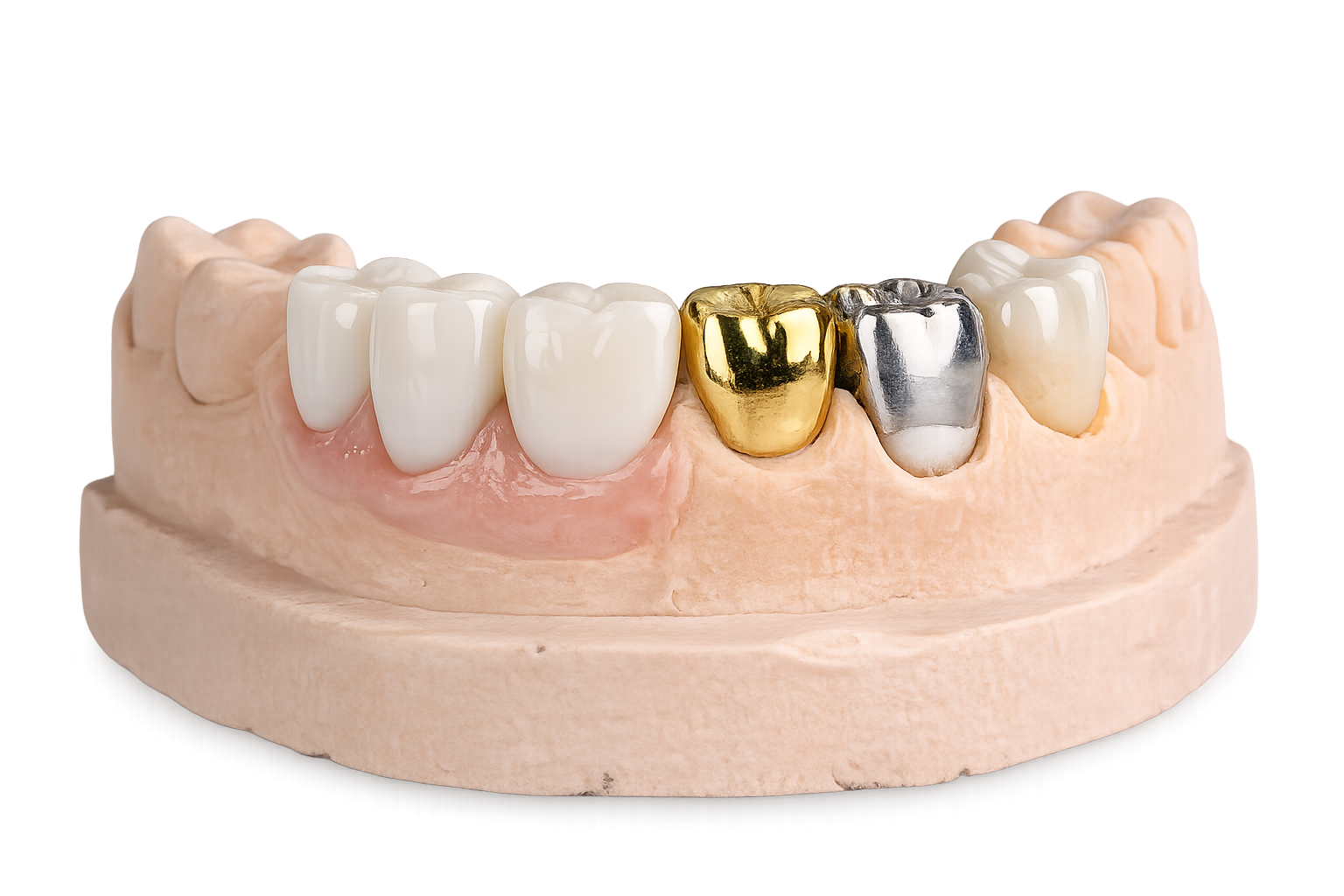
PFM & Gold Remain Useful Clinical Options
PFM and full-cast gold restorations still serve situations in which their material properties fit the clinical objective. They should not be prepared according to the same geometry.
A PFM crown requires room for both the metal framework and veneering ceramic. Where porcelain is needed, insufficient reduction can force the laboratory to choose between an overcontoured crown and inadequate material support. A porcelain-bearing margin generally needs a shoulder, while a metal margin may use a chamfer.
Full-cast gold can support a more conservative preparation because no veneering ceramic must be accommodated. A continuous chamfer, rounded internal angles, anatomical occlusal reduction, and adequate functional cusp clearance help preserve tooth structure without leaving the casting too thin.
The word “gold” is not a complete material prescription. Alloy composition, restoration design, occlusal load, esthetic expectations, and the intended cementation approach should be established with the laboratory.
Five Details to Send Before Fabrication
The preparation scan or impression is only part of the information needed for predictable material selection. Include the following with the case:
- Exact material request: Specify the product and formulation when known, not simply “zirconia” or “ceramic.”
- Restoration design: Identify whether the case is monolithic, facially layered, fully layered, full cast, or metal-ceramic.
- Occlusal conditions: Note limited clearance, heavy function, parafunction, opposing restorative materials, or restricted restorative space.
- Esthetic records: Provide the final shade, stump shade, photographs, characterization requests, and information about adjacent restorations.
- Cementation plan: Confirm whether the preparation and clinical conditions support adhesive, self-adhesive, or conventional cementation under the selected material’s current instructions.
Sending these details early gives the technician an opportunity to identify a conflict before fabrication. It is easier to revise the material plan or preparation while the case is still being designed than after the definitive restoration reaches the operatory.
When to Contact the Laboratory Before Preparing
Contact the laboratory before final preparation when the case has limited occlusal clearance, a discolored preparation, a short clinical crown, a deep margin, a bridge span, an implant component, heavy parafunction, or competing strength and esthetic requirements.
Early communication is also valuable when choosing among multiple zirconia formulations. A material that works well for a monolithic posterior crown may not provide the translucency desired for a highly visible anterior case. Conversely, the most translucent option may not be appropriate for every loading condition or span.
Upper Valley Dental Laboratory works with practices in Rexburg, Jerome, Ammon, and Pocatello through a combination of direct communication and digital case submission. Your scan, photographs, prescription, and clinical notes give the CDT team the information needed to review restorative space and material selection before fabrication begins.
Plan Your Next Case with a CDT-Owned Laboratory in Rexburg, ID
Predictable crown-and-bridge results begin with alignment between the preparation, material, restoration design, and laboratory workflow. Upper Valley Dental Laboratory provides CDT-reviewed case support, digital submission, in-house CAD design, and 5-axis milling for dental practices in Rexburg, Jerome, Ammon, Pocatello, and the surrounding eastern Idaho region. Contact us today to submit your first case or request lab details.