Zirconia vs. PFM vs. Gold Crowns: A Case Selection Guide | Upper Valley Dental Laboratory
Which Crown Material Is Best for Your Dental Case?
Choosing between zirconia, porcelain-fused-to-metal (PFM), and gold begins with the clinical demands of the case. Tooth position, restorative space, esthetic expectations, opposing dentition, preparation geometry, span length, and parafunction all affect which material offers the best balance of strength and long-term performance.
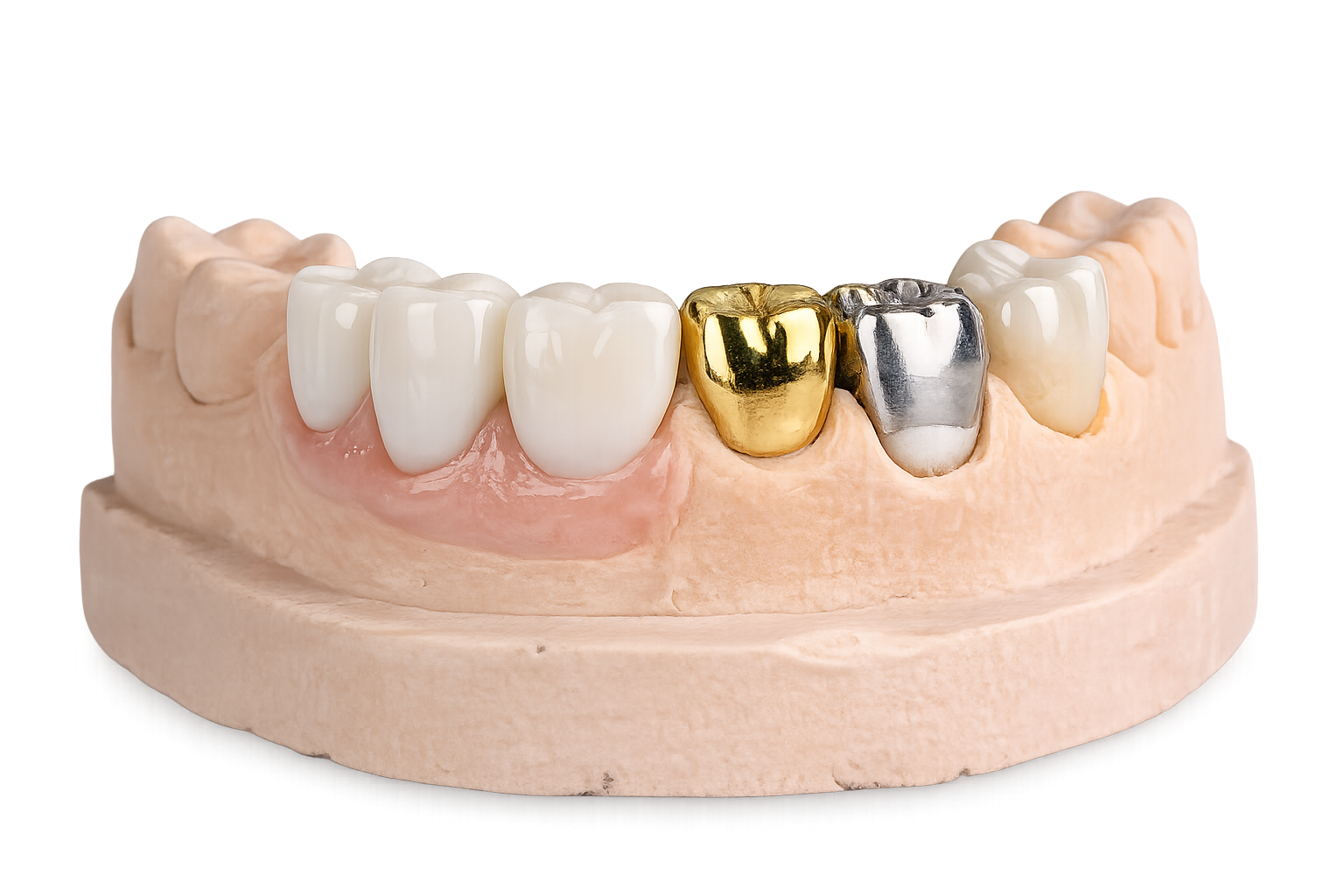
Monolithic zirconia is a practical choice for most posterior single crowns and many esthetic cases requiring a strong, metal-free restoration. PFM remains valuable when an established metal framework offers a clear advantage, while gold is especially useful for posterior cases involving limited clearance, heavy parafunction, or vulnerable opposing enamel.
Upper Valley Dental Laboratory fabricates all three options for practices throughout Rexburg, Idaho Falls, Pocatello, and Logan, UT. This guide provides a practical framework for selecting the right material for each case.
Start With the Clinical Demands of the Crown
Before comparing materials, identify the factors most likely to affect the restoration after delivery. A crown in the anterior esthetic zone presents a different set of priorities than a second molar in a patient with a heavy functional load.
The most useful questions include:
- How much occlusal and axial clearance is available?
- Is the preparation retentive enough for the planned restoration?
- Will the crown oppose natural enamel, another ceramic restoration, or a removable prosthesis?
- Does the patient show signs of bruxism or another parafunctional habit?
- Is the restoration in the esthetic zone?
- Is the case a single unit or part of a fixed dental prosthesis?
- Are there dark preparations, metal posts, or discolored substrates to mask
- Will the material allow adequate connector dimensions and framework support?
- Does the patient have a metal sensitivity or a strong preference for a metal-free restoration?
No single answer selects the material automatically. Together, however, these details usually point toward the option with the best balance of strength, esthetics, preparation requirements, and long-term serviceability.
Zirconia Crowns for Strength & Versatility
Zirconia is a practical choice for many posterior crowns and an increasing number of anterior cases. Monolithic zirconia provides substantial strength without a separate veneering layer, reducing one common source of ceramic chipping.
Best suited for:
- Posterior single-unit crowns exposed to substantial occlusal load
- Patients with mild-to-moderate parafunction when the occlusion is carefully managed
- Cases requiring a metal-free restoration
- Implant crowns where strength and controlled contours are priorities
- Dark preparations or metal components that require masking
Trade-offs: Zirconia formulations differ in strength, opacity, and translucency. Layered zirconia can provide greater characterization but introduces a veneering layer that may chip. Adjusted zirconia must also be thoroughly repolished to protect the opposing dentition.
Higher-strength zirconias generally provide more opacity, while more translucent generations improve esthetics with some reduction in mechanical properties. Material selection should reflect whether the case places greater emphasis on load resistance, natural translucency, or substrate masking.
Preparation requirements also vary by product and indication. Some monolithic systems can be used at comparatively conservative thicknesses, but minimum reduction should follow the manufacturer’s instructions and the laboratory’s design requirements. More translucent materials, layered restorations, connectors, and high-load areas may require additional room.
PFM Crowns for Established Clinical Predictability
PFM restorations combine a metal coping or framework with veneering porcelain. Although zirconia has replaced PFM in many routine single-unit cases, a metal-ceramic restoration remains useful when framework rigidity, substrate masking, or a metal occlusal surface provides a clear advantage.
Best suited for:
- Selected multi-unit restorations
- Preparations with compromised geometry
- Cases requiring effective masking of a dark preparation or metal post
- Restorations designed with a metal margin or metal occlusal surface
- Clinicians who value the extensive clinical history of metal-ceramic restorations
Trade-offs: The metal substructure can limit light transmission, and gingival recession may eventually reveal a dark cervical area or metal margin. Veneering porcelain can also fracture or chip when it lacks adequate framework support or is exposed to unfavorable occlusal forces.
PFM can be useful when clearance is limited in a specific area and the restoration can be designed with metal at the occlusal contact. A porcelain-covered PFM crown, however, still needs room for both the metal substructure and the veneering ceramic. It should not automatically be considered a conservative option in every limited-clearance case.
PFM is not the default choice it once was, but it remains a dependable option when the framework provides a meaningful clinical benefit.
Gold Crowns for Conservative Posterior Function
Full-cast gold remains one of the most functionally forgiving crown materials available. It is not brittle, can be finished accurately at the margin, and can often function with less restorative thickness than porcelain-based alternatives.
Best suited for:
- Second and third molars outside the visible smile zone
- Heavy bruxers when opposing enamel wear is a concern
- Cases with limited occlusal clearance
- Short clinical crowns where conservative reduction is important
- Patients who prioritize function and longevity over tooth-colored esthetics
Trade-offs: Gold is visibly metallic, making it unsuitable for patients who prioritize a tooth-colored restoration. Alloy cost can also affect case acceptance, even when gold is the strongest functional option.
Gold’s ductility allows it to tolerate functional stress without the brittle fracture behavior associated with ceramics. Its wear characteristics are also favorable when the restoration opposes natural enamel. Occlusal adjustment and polishing are straightforward, and a full-cast crown does not carry the veneering porcelain chipping risk found in layered systems.
For posterior cases involving minimal clearance, heavy parafunction, or vulnerable opposing teeth, gold remains an option worth discussing rather than dismissing solely because it is not tooth colored.
Zirconia vs. PFM vs. Gold at a Glance
| Consideration | Zirconia | PFM | Gold |
|---|---|---|---|
| Esthetic zone | Excellent | Good | Not recommended |
| Heavy occlusal load | Very good | Good | Excellent |
| Minimal reduction | Excellent | Fair | Excellent |
| Opposing natural dentition | Good (polished) | Good | Excellent |
| Long-span bridge | Fair | Excellent | Good |
How to Choose the Crown Material by Case Type
For a routine posterior single crown with adequate reduction, monolithic zirconia often provides a practical balance of strength, efficiency, and acceptable esthetics. The laboratory can select a zirconia formulation that matches the functional and shade requirements of the case.
For a highly visible anterior crown, the decision requires more than choosing “zirconia.” The shade of the preparation, stump color, required translucency, restorative thickness, and neighboring dentition all matter. A more translucent zirconia or a carefully layered design may be indicated, while a darker substrate may require a more opaque material.
For a posterior tooth with very limited clearance, gold deserves serious consideration. A metal occlusal PFM design may also work when the patient accepts visible metal. Selecting a tooth-colored restoration without enough room can leave the laboratory trying to balance contour, strength, and occlusion within an unfavorable preparation.
For a heavy bruxer, the evaluation should include available thickness, opposing dentition, excursive contacts, and the patient’s history of fractured restorations. Monolithic zirconia may provide the required strength, while gold may offer a more forgiving relationship with opposing enamel. An occlusal appliance may also be appropriate when clinically indicated.
For a fixed dental prosthesis, span length alone should not determine the material. Abutment support, connector dimensions, pontic design, restorative space, esthetic expectations, and the requirements of the selected system all influence whether PFM or zirconia is the stronger choice.
Give the Laboratory the Information Behind the Prescription
A material prescription is more useful when the laboratory also understands why it was selected. Photographs, preparation scans, stump shades, opposing dentition, occlusal records, and notes about parafunction help the technician design the restoration around the actual case.
For anterior work, include shade photographs with a reference tab and communicate whether the priority is translucency, masking, or matching existing restorations. For high-load posterior cases, identify bruxism, restricted restorative space, or a history of ceramic fracture. For multi-unit cases, confirm the span, connector space, path of insertion, and any limitations created by the preparations.
Early communication is especially valuable when two materials appear equally reasonable. A brief laboratory consultation before finalizing the preparation or prescription can prevent compromises in thickness, contour, connector design, or shade.
FAQs
Is Zirconia Strong Enough for a Molar With No Cusp Coverage?
A conventional crown normally covers the cusps, so a molar restoration with no cusp coverage would not be considered a traditional full-coverage crown. If the question refers to a preparation with limited occlusal clearance, full-contour monolithic zirconia may still be appropriate, provided the preparation maintains the minimum material thickness required for the specific zirconia system. The laboratory should review the scan before fabrication when clearance is limited.
Does Zirconia Wear Opposing Teeth Faster Than PFM or Gold?
Zirconia’s effect on opposing enamel depends heavily on surface condition. Smoothly polished monolithic zirconia generally produces more favorable wear behavior than a rough, adjusted, or inadequately polished surface. Glaze alone is not a replacement for proper polishing because it can wear away during function.
Gold remains especially favorable to opposing enamel. PFM wear behavior depends on whether the opposing contact is on metal or porcelain and on the finish of that surface.
When Is Gold a Better Clinical Choice Than Zirconia?
Gold may be preferable when occlusal clearance is minimal, the patient has heavy parafunction, the restoration opposes vulnerable natural enamel, or conservative tooth reduction is a priority. It is particularly useful for second and third molars where appearance is less important.
The final choice still depends on patient acceptance, alloy cost, preparation design, and the location of the crown.
When Should a PFM Crown Be Chosen Over Zirconia?
PFM remains valuable when an established metal framework design provides a clear advantage, such as selected multi-unit restorations, cases requiring strong substrate masking, or restorations designed with a metal margin or metal occlusal surface. It may also suit clinicians who want to rely on the extensive clinical history of metal-ceramic restorations.
The decision should account for the esthetic limitations of the metal substructure and the possibility of veneering porcelain chipping.
Discuss Your Next Crown Case With Our Laboratory
The best crown material is the one that matches the preparation, functional load, restorative space, esthetic expectations, and opposing dentition. Zirconia offers strength and versatility, PFM provides an established metal-supported solution, and gold remains an excellent functional option for demanding posterior cases.
Upper Valley Dental Laboratory supports practices across Rexburg, Twin Falls, Jerome, Ammon, and Chubbuck, along with Smithfield and North Logan, UT. Contact us to discuss your next case or explore our zirconia, PFM, and gold crown services.